BIOGRAPHY
Martin Mwangi Thuo is a Professor in the Department of Materials Science & Engineering at North Carolina State University and the Deputy Director of NSF-STC Center for Complex Particle Systems (COMPASS). He is a Fellow of the National Academy of Inventors (FNAI) and a Fellow of the Africa Academy of Sciences (FAAS). He was a Mary-Fieser (2009-2011) and NSEC (2011-2013) Postdoctoral Fellow at Harvard University under Prof. George M. Whitesides. He is the recipient of several awards including the ACS Nano Rising Star Award, the Schafer 2050 Professorship, Akinc Excellence in Research Award, Lynn-Anderson Research Excellence Award, Black & Veatch Faculty Fellowship, among others. He is a co-host of the ICAN-X talks, and he serves on the boards of various journals and professional societies. His research interests encompass the general theme of frugal innovation through simplicity and surface thermodynamics. He holds >70 patents worldwide and has >100 publications.
ABSTRACT
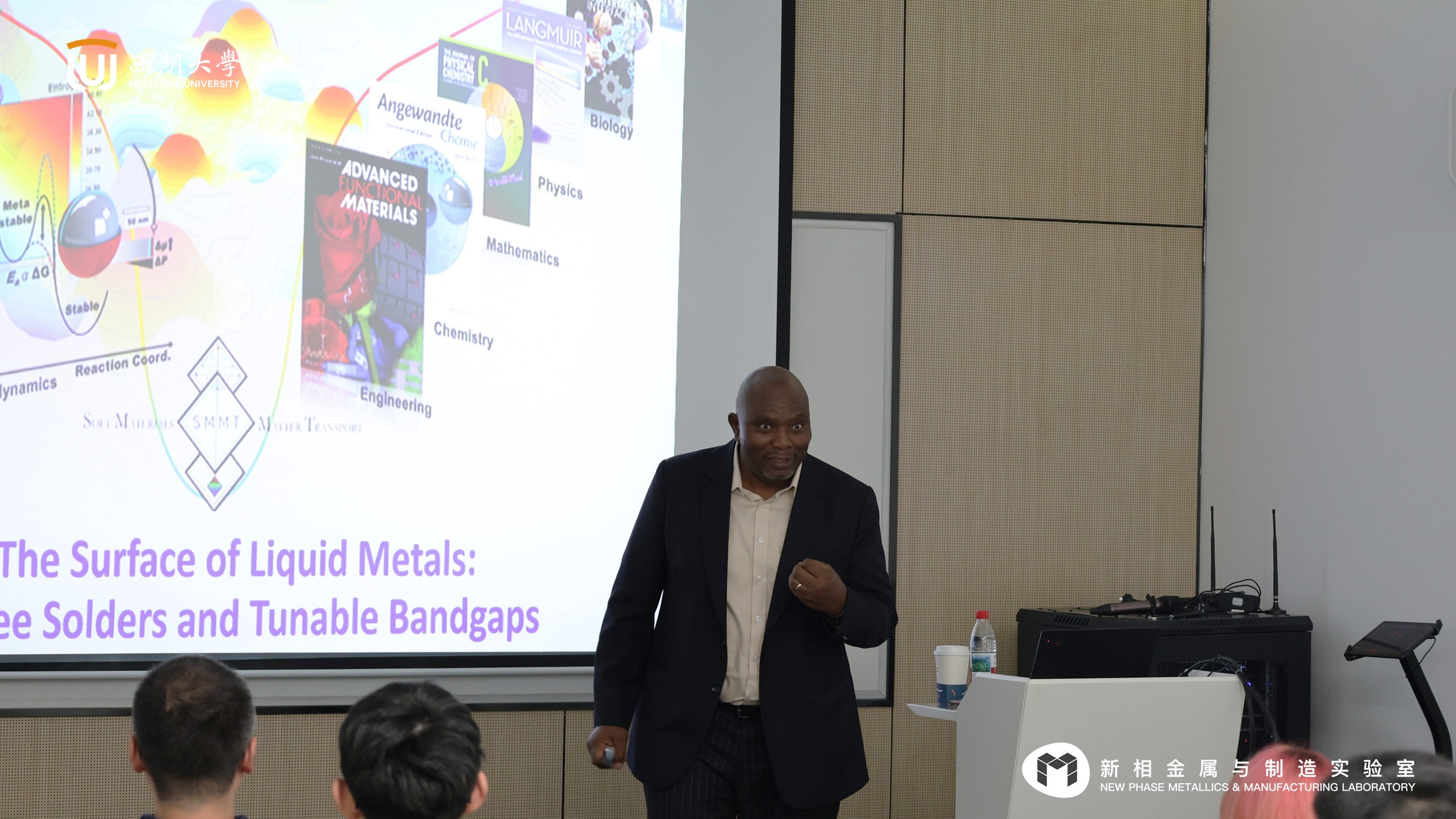
Advances in flexible electronics demand new low-temperature solders while a changing climate calls for affordable approaches to catalyst design and bandgap engineering. We couple fundamental surface thermodynamics and autonomous processes to address these challenges. This talk explores; i) How complexity in composition of nanoscale (~5 nm thickness) passivating metal oxides can be used to frustrate solidification of metallic particles and induce significant undercooling. The resulting metal particles are used as heat-free solders and formulated as metal inks for printing conductive traces. ii) Speciation in the passivating oxide is used as a filter (gate) to controllably introduce reactive metal ions into a solution. Multi-metal center organometallic components/wires are therefore made and either locally deposited or in situ self-assembled through polymerization-induced self-assembly of 1D organometallic adducts. This process being a living polymerization, ad infinitum growth leads to high aspect ratio organometallic nanomaterials. Post-synthesis pyrolysis of the ligands leads to carbon-coated metal oxides that show catalytic activity atypical of the parent oxide and unique transistor behavior hinting to low-cost fabrication of diodes, gates, and other microelectronic components. Guided deposition of these organometallic adducts allows for multi-semiconductor FINFET morphologies that are realized without the need for typical complex fabrication processes. In conclusion, we highlight the versatility of nanoscale surfaces/interfaces in liquid metals as a pathway to neoteric materials or technologies.